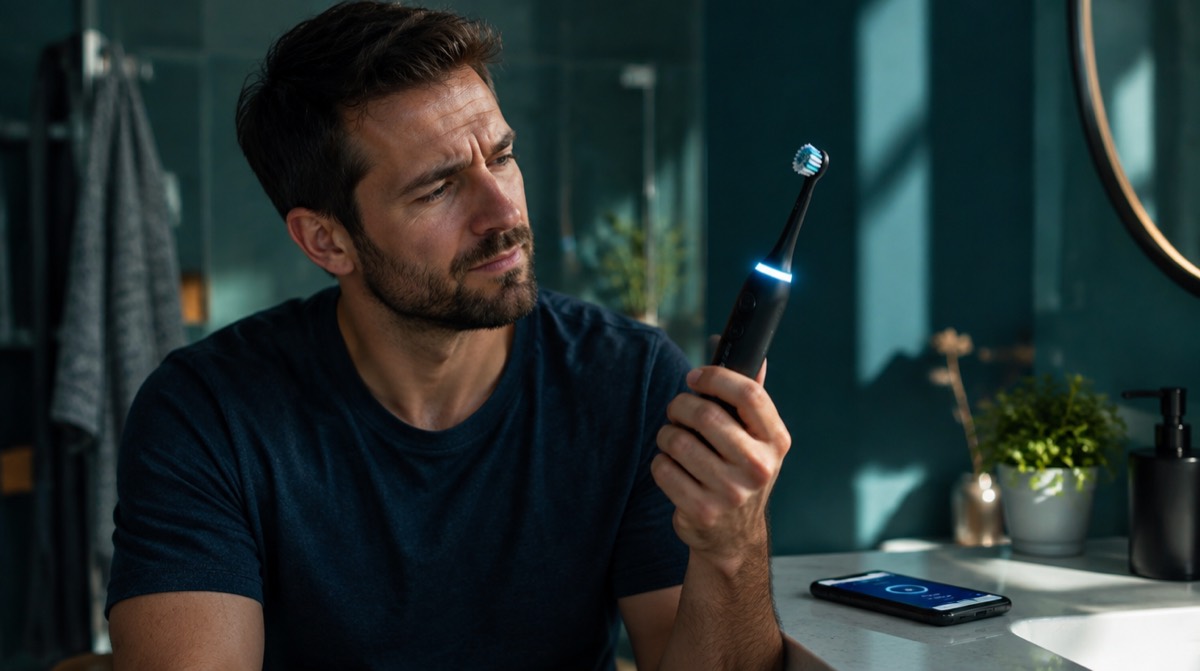
The Oral-B iO is Oral-B’s premium electric toothbrush line, using a frictionless magnetic drive instead of a geared motor for a quieter, smoother oscillating-rotating action, a colour-coded “smart” pressure ring that shows too little, right, and too much pressure, and a Bluetooth app with brushing-zone tracking on higher models. It cleans very well. So does Oral-B’s $30 Pro 1000, which uses the same oscillating-rotating principle with a louder motor and a simpler pressure sensor. The iO is worth its $80 to $300 price if the quieter feel and pressure feedback get you to brush properly twice a day; it is not measurably better at removing plaque.
Quick verdict: is the Oral-B iO worth it?
- Worth it if you tend to brush too hard, find a standard Oral-B too loud, or the price is comfortable. The quiet feel and the pressure ring are the real upgrades.
- Best value: the iO3 (about $80 to $100), or the iO4 if you want the app. Both have every feature that affects cleaning.
- Skip it if you want the cleanest teeth for the least money. A $30 to $50 Oral-B with a timer and pressure sensor cleans just as well.
- Hidden cost: iO-only brush heads at roughly $8 to $12 each, about $40 a year.
What the iO does differently
Magnetic drive. Conventional Oral-B brushes spin the head with a small geared motor, which is effective and noisy. The iO uses a linear magnetic drive that moves the head with less vibration transferred to the handle. The result is noticeably quieter and smoother, more like a sonic brush in feel while keeping the small round oscillating head. This is the feature people tend to love.
Smart pressure ring. A light ring around the neck glows white for too little pressure, green for the right range, and red for too much, and the motor slows when you press too hard. Ordinary pressure sensors only warn on too hard; the iO’s is the first to tell you when you are too gentle. For anyone who has been told they brush too hard, it is genuinely useful.
Interactive display (iO6 and up). A small screen on the handle shows mode, timer, battery, and a smiley at the end of a full two minutes.
App and position tracking (iO4 and up; 3D tracking on iO8+). The app maps which areas you brushed and which you missed. Clever for the first fortnight; most people stop opening it.
Modes. Three on the iO3, up to seven on the iO10. Daily Clean is the one that matters.
Charging. Magnetic charger, three-hour charge on higher models, about two weeks of battery.
The line-up
| Model | Typical price | Pressure ring | Screen | App | Modes | Worth it? |
|---|---|---|---|---|---|---|
| iO3 | $80 – $100 | Yes | No | No | 3 | Best value in the range |
| iO4 | $100 – $130 | Yes | No | Yes | 4 | Good if you want the app |
| iO5 / iO6 | $130 – $180 | Yes | Yes | Yes | 5 | Screen and travel case |
| iO7 / iO8 | $180 – $250 | Yes | Colour | Yes, 3D tracking | 6 | Diminishing returns |
| iO9 / iO10 | $250 – $350 | Yes | Colour | Yes, live coaching | 7 | Gadget-tier |
Every model from the iO3 up has the magnetic drive, the smart pressure ring, and the two-minute timer with pacer. Those are the three things that touch your teeth. Everything above the iO4 is display, modes, and packaging.
Best value Oral-B iO: iO2 vs iO3 vs iO4
If you only want the iO’s magnetic drive and quiet feel, the decision sits in the bottom three models. Oral-B’s own line-up guide (updated August 2026) lists them at about $65, $90 and $100, though retailers often discount them.
- iO2 (about $65): the cheapest way into the iO range. It has a pressure sensor that slows the brush when you press too hard, but no visible light ring, and no whitening mode. Its modes are Daily Clean, Sensitive and Super Sensitive.
- iO3 (about $90): adds the visible three-colour pressure ring and a whitening mode. For most people this is the best value iO.
- iO4 (about $100): four modes, adding Super Sensitive to the iO3’s three. Worth the extra $10 only if you want that gentler setting.
Bluetooth app tracking starts at the iO5, and a built-in display starts at the iO6. None of that changes how the brush head cleans.
What “Professional Clean” and “Ultimate Clean” mean
You will see iO brushes sold with names like “Professional Clean” or “Ultimate Clean”. These are not separate models. “Ultimate Clean” is the name of Oral-B’s standard iO brush head (others include Gentle Care, Gum Care, Whitening and Targeted Clean), and “professional clean” is marketing wording for the feel after brushing. To compare two listings, look for the handle number, iO2 through iO10. That number tells you what features you are paying for. The brush heads fit every iO handle, which is why the head, not the handle, is the long-term cost.
Source: Oral-B, Which Oral-B iO electric toothbrush is right for you?
How well does it clean?
Oscillating-rotating brushes have the strongest evidence of any powered toothbrush type, and the iO is an oscillating-rotating brush. Oral-B-funded studies show the iO reduces plaque and gingivitis more than a manual brush and slightly more than a sonic comparator. What no independent trial has shown is that the iO cleans better than Oral-B’s own geared models, which use the same head motion. The pressure ring may improve results indirectly by stopping you scrubbing, and the quieter feel may get you to brush the full two minutes; neither is the same as the brush itself removing more plaque.
For the ADA’s part, several Oral-B models including iO handles carry the Seal of Acceptance for safety and effectiveness. So do many $30 brushes.
Brush heads
The iO uses its own head design, not compatible with standard Oral-B heads. Genuine iO heads cost roughly $8 to $12 each; standard Oral-B heads $4 to $8; third-party alternatives for iO are fewer and of mixed quality. At four heads a year, the iO costs about $16 to $20 more per year in heads. Over a three-year handle life, that is $50 to $60, which is roughly the price gap between an iO3 and a Pro 1000 all over again.
Head options: Ultimate Clean (the standard), Gentle Care (softer, for sensitive gums), Radiant White (polishing cup), and Specialised Clean. Ultimate Clean or Gentle Care are the ones to use.
Oral-B iO vs Philips Sonicare
The iO’s main rival is Philips Sonicare, which uses a sonic side-to-side motion and a larger, conventionally shaped head instead of a small round head that rotates. Both styles clean well when used properly for two minutes. Systematic reviews give oscillating-rotating brushes like the iO the strongest evidence of any powered brush, but the head-to-head gaps between the two brands are small, and most of those comparisons are funded by one manufacturer or the other. Choose on feel: if you like a small head that cups each tooth, stay with Oral-B; if you prefer a gentler sweeping sensation, try a Sonicare.
| Brush | Motion | Pressure feedback | Typical price | Replacement heads |
|---|---|---|---|---|
| Oral-B iO3 | Oscillating-rotating, magnetic drive | Three-colour ring (too soft, right, too hard) | $80 – $100 | $8 – $12 each |
| Oral-B Pro 1000 | Oscillating-rotating, geared motor | Warns when too hard | $30 – $50 | $4 – $8 each |
| Philips Sonicare 4100 | Sonic, side to side | Warns when too hard | $40 – $60 | $6 – $10 each |
| Philips Sonicare DiamondClean 9000 | Sonic, side to side | Warns when too hard, with app | $180 – $230 | $8 – $12 each |
The pattern is the same on both sides: the entry models with a timer and pressure warning do the cleaning, and the premium models add comfort, screens and apps. The iO’s three-colour ring is the one premium feature that changes how people brush, because it is the only one that also tells you when you are pressing too lightly.
Who should buy an iO
- Someone who has been told they brush too hard and wants live feedback
- Someone who finds a standard Oral-B too loud or too buzzy and would otherwise stop using it
- Someone who enjoys the tech and will use the app or screen for motivation
- Someone replacing a broken premium brush who is already used to the feel
Who shouldn’t
- Anyone on a budget: a $30 to $50 Oral-B with a timer and pressure sensor cleans the same
- Anyone who will not use the app; the iO3 is the better buy than the iO8 for them
- Anyone with a house full of standard Oral-B heads
- Anyone expecting the brush to fix bleeding gums by itself; technique and flossing do that
Verdict
The iO3 or iO4 is a genuinely nice toothbrush, and the pressure ring is the best implementation of that feature on the market. If $80 to $130 is comfortable and the feel matters to you, buy one and be happy. The iO7 to iO10 are lovely objects that clean exactly the same. And if what you want is clean teeth for the least money, our electric toothbrush guide explains why the $30 to $50 tier remains the smart choice. Whatever you buy, use it with the technique in our brushing guide and clean between your teeth daily.
When to see a dentist
No toothbrush replaces a check-up. See a dentist if your gums bleed after two weeks of gentle, proper brushing; if the pressure ring shows red every time and you have receding gums or notches at the gum line, which suggests existing damage from hard brushing; if you have persistent sensitivity; or if you have not had a professional cleaning in the past year. Ask the hygienist to watch you use the brush; the position tracking in an app is no substitute for a person who can see your mouth.
Frequently asked questions
Is the Oral-B iO better than the Pro 1000?
At cleaning teeth, not measurably. Both are oscillating-rotating brushes with a timer and pressure sensor. The iO is quieter, smoother, and has a three-colour pressure ring; the Pro 1000 costs a third as much and uses cheaper heads.
Which Oral-B iO model is best?
The iO3 or iO4. They have the magnetic drive, smart pressure ring, and timer, which are the features that affect cleaning. Higher models add screens, modes, and app tracking.
Are Oral-B iO brush heads expensive?
Yes, about $8 to $12 each for genuine heads, versus $4 to $8 for standard Oral-B heads. They are not cross-compatible. Budget about $40 a year.
Is the Oral-B iO worth it?
If you value the quiet feel and the pressure feedback and the price is comfortable, yes. If you want the cleanest teeth for the least money, a $30 to $50 Oral-B is the better buy.
Does the Oral-B iO whiten teeth?
No electric toothbrush whitens beyond removing surface stains, which any brush does. The “Whitening” mode and polishing head remove stains slightly faster; they do not change tooth colour.
Oral-B iO or Sonicare: which is better?
Neither is clearly better at cleaning. The iO uses a small rotating head with the strongest evidence for plaque removal; Sonicare uses a sonic side-to-side motion that many people find gentler. Pick the feel you will use for two minutes twice a day.