
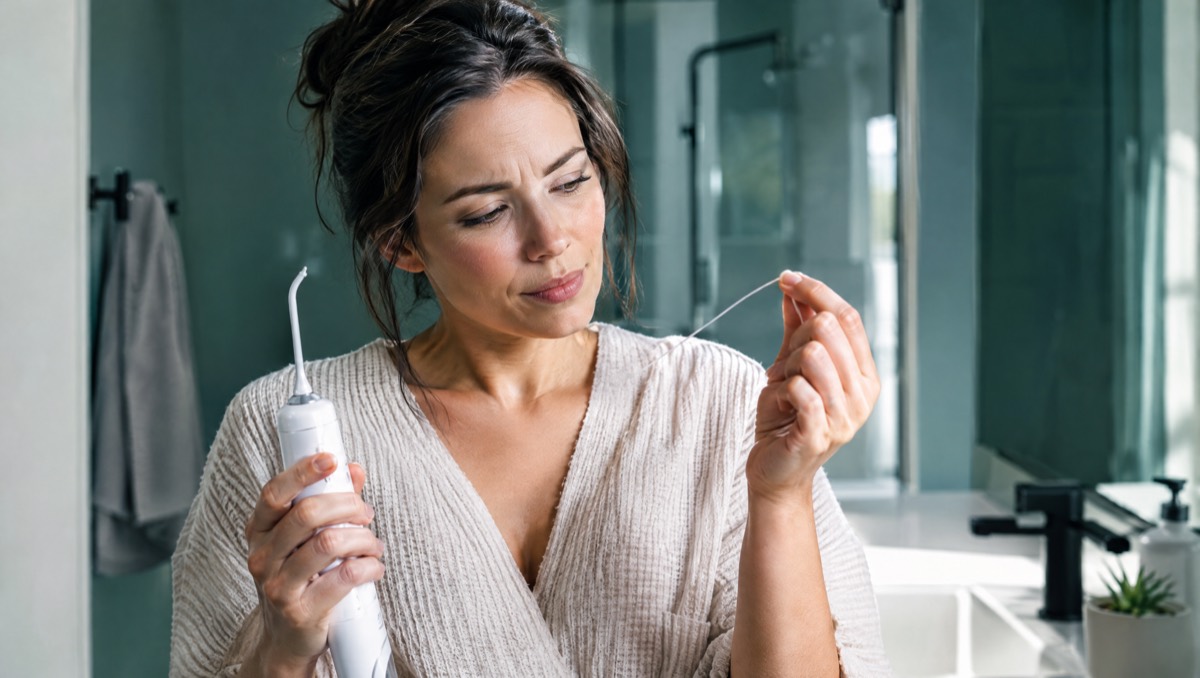
A Waterpik (water flosser) and string floss both clean between your teeth, and for most people either one counts as daily interdental cleaning. Small trials suggest water flossers remove plaque at least as well as floss and may reduce gum bleeding more, but the evidence is low certainty. The better choice is the one you will actually use every day.
Quick verdict
- Choose a water flosser if you have braces, a fixed bridge or implants, find string floss hard to handle, or keep skipping flossing because you dislike it.
- Choose string floss if you want the cheapest option, travel a lot, have tight contacts between teeth, or already floss every day without trouble.
- Cost difference: a roll of floss costs a few dollars; a water flosser typically costs about $40 to $100, plus replacement tips.
- The catch: the research behind both is weaker than most people assume. Neither has been shown to prevent cavities in good-quality trials.
How each one cleans
String floss is a thin strand you wrap around the side of each tooth in a C shape and slide gently below the gum line. It scrapes the sticky film of bacteria (plaque) off the tooth surface where neighbouring teeth touch, a spot a toothbrush cannot reach. Our guide on how often you should floss covers timing and technique.
A water flosser (also called an oral irrigator; Waterpik is the best-known brand) pumps a thin, pulsing stream of water from a reservoir through a handheld tip. You trace the tip along the gum line and pause between teeth. The pulses flush out food and disturb plaque between teeth and just under the gum edge. Our water flosser guide explains the types and features in more detail.
Side-by-side comparison
| Water flosser (e.g. Waterpik) | String floss | |
|---|---|---|
| How it works | Pulsing water stream from a tip | Strand scrapes plaque from tooth sides |
| Up-front cost | About $40 to $100 for most countertop and cordless models | A few dollars per pack |
| Ongoing cost | Replacement tips every few months | New pack every month or two |
| Time per session | About 1 to 2 minutes | About 2 to 3 minutes once practiced |
| Braces, bridges, implants | Easy to use around hardware | Needs floss threaders or special floss |
| Tight contacts | Cleans around them, does not scrape the contact itself | Reaches the contact point directly |
| Portability | Needs counter space, water, and power or charging | Fits in a pocket |
| ADA Seal | Available on some models | Available on many brands |
Prices are typical US retail ranges and change often, especially around sales.
Is a Waterpik better than floss? What the research says
The best summary of the evidence is a 2019 Cochrane review of 35 trials on interdental cleaning. It found that adding floss to toothbrushing may reduce gingivitis (gum inflammation) in the short term. Water flossers and interdental brushes seemed to come out slightly better than floss for gingivitis, but the certainty of that evidence was low to very low. The trials were short, most people in them had mild gum inflammation, and none measured cavities.
A 2024 systematic review in the Journal of Indian Society of Periodontology looked only at plaque and found that most of the seven trials it included favoured water flossers over floss. Its authors suggested water flossers as an alternative for people with limited dexterity, braces or dental prostheses. Several individual trials have also reported less gum bleeding with water flossers than with floss, though some of the best-known ones were run with the manufacturer’s involvement.
The fair reading: water flossers look at least as good as floss for plaque between teeth, and may be a little better for bleeding gums. The differences are small, the studies are small, and good daily habits matter more than the tool.
Do you need to floss if you use a Waterpik?
For most people, the ADA’s guidance is simply to clean between the teeth once a day, and it lists water flossers as one way to do it. MouthHealthy describes ADA-accepted water flossers as tested to remove plaque and help reduce gingivitis, and as an option for people who have trouble flossing by hand or have braces or bridges.
Some people use both: a water flosser to flush around brackets or the gum line, and floss for tight spots where food packs in. That is a preference, not a requirement. If your dentist or hygienist has noticed plaque or tartar building up in particular spots, ask which tool reaches those areas best for your mouth.
Which is better for your situation?
Braces. Water flossers are much easier to use around brackets and wires than string floss, which has to be threaded under the wire for every tooth. Mayo Clinic notes a water flosser can help people whose braces or dental work make floss hard to use. See our guide to braces for adults for other cleaning tips during treatment.
Bridges and implants. Water flushes under a fixed bridge and around implant crowns without threading. Some people still use special floss or small interdental brushes in addition.
Arthritis or limited hand movement. A water flosser needs much less finger control. Floss holders and pre-threaded flossers are a cheaper alternative worth trying first.
Bleeding or puffy gums. Both can help. Some bleeding when you first start cleaning between teeth is common and often eases as daily cleaning becomes routine. Bleeding that does not settle is a reason to see a dentist.
Tight budget or frequent travel. Floss wins. It is cheap, needs no power or water tank, and fits in a bag.
Cost of ownership
- Floss: roughly $2 to $5 a pack, so a few dollars a month for daily use.
- Water flosser: about $40 to $100 for the unit. Countertop models usually have stronger pumps and bigger reservoirs; cordless models are smaller and easier to travel with but have smaller tanks.
- Replacement tips: most manufacturers recommend changing tips every few months. Check the price of genuine tips before you buy a unit.
What to look for in a water flosser
Worth it: the ADA Seal of Acceptance (check the ADA’s list of accepted products for the specific model), adjustable pressure so you can start low, and a reservoir big enough for a full session.
Nice but optional: orthodontic or plaque-seeker tips, a built-in timer, a cordless design for small bathrooms or travel.
Rarely needed: many pressure settings beyond a few, or bundled toothbrush combos unless you want both.
Mayo Clinic also advises not sharing a water flosser, to reduce the risk of spreading bacteria. Give each family member their own tip.
When to see a dentist
See a dentist if your gums still bleed after two weeks of gentle daily cleaning, if your gums look red, swollen or are pulling away from your teeth, if you notice persistent bad breath, a loose tooth, or pus around a tooth, or if food keeps getting stuck in the same spot. That last one can mean a cavity or a gap that needs attention. A hygienist can also check your technique with either tool at your next cleaning.
Frequently asked questions
Is a Waterpik better than floss?
Small studies suggest water flossers remove plaque at least as well as floss and may reduce gum bleeding slightly more, but a 2019 Cochrane review rated this evidence as low certainty. Both count as cleaning between your teeth. The better option is the one you will use every day without skipping.
Can a Waterpik replace flossing?
For many people, yes. The ADA recommends cleaning between your teeth once a day and lists water flossers as one way to do it, especially for people with braces, bridges, or trouble flossing by hand. If plaque keeps building up in specific spots, ask your dentist whether floss or another tool would reach them better.
Should you use a Waterpik before or after brushing?
There is no strong evidence that the order matters. Many people use a water flosser before brushing so loosened debris gets brushed away, while others prefer after. Choose the order that makes it easiest to do both every day, and follow your device’s instructions on water temperature and pressure.
Is a water flosser good for braces?
Yes. Water flossers make it much easier to clean around brackets and under wires than string floss, which must be threaded under the wire. ADA’s MouthHealthy and Mayo Clinic both mention braces as a reason to consider one. Many orthodontists also suggest a small interdental brush for around brackets.
Can a Waterpik damage your gums?
Used as directed at a comfortable pressure, water flossers are considered safe for gums. Start on the lowest setting, aim the tip along the gum line rather than straight into the gum, and increase slowly. If you have recent gum surgery or an extraction, ask your dentist before using one near the area.