
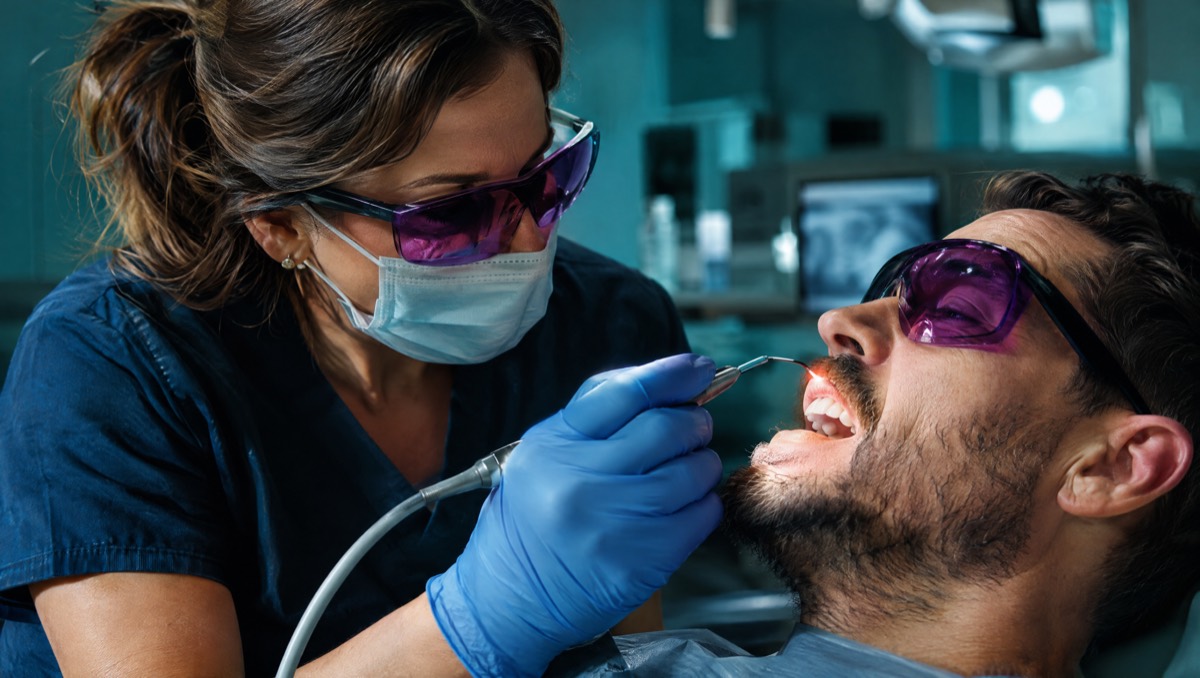
Gum contouring, also called gingival sculpting or a gingivectomy when tissue is removed, reshapes the gum line to make teeth look longer, more even, or less covered by gum. It is done with a soft-tissue laser, a scalpel, or electrosurgery, usually under local anaesthetic, in a single visit of 30 to 90 minutes. In the US it costs $300 to $800 per tooth, or $1,000 to $3,000 for the full visible smile. The important caveat is that not every gummy smile is a gum problem: if the cause is bone position, an overactive lip, or short teeth, cutting gum alone will not fix it and the tissue may grow back.
What it treats
A gummy smile, where more gum shows than you would like when smiling. The usual threshold for cosmetic concern is more than about 3 mm of gum visible.
An uneven gum line, where one or two teeth look shorter because the gum sits lower on them. This is often the more noticeable problem, because the eye reads asymmetry quickly.
Short-looking teeth, where the crowns are partly covered by gum that never receded after the teeth erupted (altered passive eruption).
Gum overgrowth from medications such as phenytoin, ciclosporin, and some calcium channel blockers, where contouring is functional as much as cosmetic.
Preparation for restorations, where a crown or veneer needs more tooth structure exposed, formally called crown lengthening.
Why your gums look the way they do, and why it matters
Before agreeing to contouring it is worth knowing which cause you have, because treatment differs:
| Cause | What’s happening | Right treatment |
|---|---|---|
| Altered passive eruption | Gum never finished receding after teeth erupted; teeth are a normal size but partly covered | Gum contouring, sometimes with bone reshaping |
| Excess gum tissue | Overgrowth, often medication-related | Gingivectomy, plus reviewing the medication |
| Hyperactive upper lip | The lip lifts unusually high when smiling | Lip repositioning surgery or botulinum toxin, not gum removal |
| Vertical maxillary excess | The upper jaw is longer than average | Orthognathic (jaw) surgery, or camouflage with orthodontics |
| Short clinical crowns from wear | Teeth genuinely worn down | Crown lengthening plus restorations |
| Gum recession on neighbouring teeth | The “long” teeth are the problem, not the short ones | A gum graft rather than contouring |
A practitioner who examines, measures, and takes X-rays before quoting is distinguishing between these. One who offers a price over a photograph is not.
The procedure
1. Assessment. Measurement of gum thickness, the distance from gum margin to bone, and X-rays. If the bone sits too close to where the new gum margin should be, bone must be recontoured as well; otherwise the gum simply grows back to its original position within weeks. 2. Design. The new gum line is marked out, usually aiming for symmetry between matching teeth and a margin on the lateral incisors slightly below the central incisors and canines. 3. Anaesthetic. Local injection; the procedure itself is painless. 4. Reshaping. A diode or Er:YAG laser, a scalpel, or electrosurgery removes and reshapes tissue. Lasers cauterise as they cut, so bleeding is minimal and often no sutures are needed. 5. Bone recontouring if required (crown lengthening), which involves lifting a small flap and reshaping bone, then suturing.
Soft-tissue-only contouring takes 30 to 60 minutes. With bone work, 60 to 120 minutes.
Recovery
Soft tissue only. Mild soreness for two to three days, managed with over-the-counter pain relief. Soft food for a few days, avoid the area when brushing, salt-water rinses from day two. Gums look their final shape within one to two weeks, though subtle settling continues for a month.
With bone recontouring. More discomfort, sutures for 7 to 10 days, and the gum margin continues to mature for 6 to 12 weeks. Any crowns or veneers planned for those teeth must wait until then, or the margins will end up in the wrong place.
Things that slow healing: smoking (significantly), poor plaque control, and picking at the site.
Cost
| Scope | Typical US cost |
|---|---|
| One to two teeth | $300 – $800 per tooth |
| Full visible smile, soft tissue only | $1,000 – $3,000 |
| Crown lengthening (with bone), per tooth | $700 – $1,500 |
| Full-arch crown lengthening | $2,000 – $5,000 |
Dental insurance does not cover contouring done for appearance, but frequently does cover crown lengthening when it is required to restore a tooth, for instance when decay extends below the gum. The distinction is the clinical justification, so ask the practice to code it correctly and submit for pre-authorisation.
Risks and what can go wrong
- Tissue regrowth. The most common disappointment. If bone was not reshaped where it needed to be, the gum returns toward its original level within weeks to months.
- Sensitivity at the newly exposed tooth neck, usually temporary.
- Asymmetry, if the design was not carefully planned; harder to correct afterward than to get right first time.
- Over-removal, exposing root surface that looks yellower than enamel and is vulnerable to decay. This cannot be undone without a graft.
- Infection or delayed healing, uncommon with good aftercare.
- Recession later, particularly in people with thin gum tissue.
Choose a periodontist or a dentist who does this routinely. It is a small procedure where the design, not the cutting, is the skilled part.
When to see a dentist
See a dentist or periodontist for an assessment if you are bothered by a gummy smile or an uneven gum line, and insist on an examination with X-rays rather than a quote from a photo. Go sooner, and treat it as a health issue rather than cosmetic, if gums are swollen, bleeding, or have overgrown since starting a new medication, or if a tooth has broken at or below the gum line. After contouring, contact the practice if bleeding continues beyond a day, if pain increases rather than decreases after 48 hours, if there is swelling or discharge, or if the gum appears to be returning to its old position within the first few months.
Frequently asked questions
How much does gum contouring cost?
$300 to $800 per tooth in the US, or roughly $1,000 to $3,000 for the full visible smile. Crown lengthening involving bone costs more, $700 to $1,500 per tooth, and is more often covered by insurance when restorative work requires it.
Does gum contouring hurt?
The procedure itself is painless under local anaesthetic. Afterward expect mild soreness for two to three days with soft-tissue work, longer if bone was reshaped. Over-the-counter pain relief is usually enough.
Do gums grow back after contouring?
Properly planned soft-tissue contouring is permanent. Gum does regrow if the underlying bone sat too close to the new margin and was not recontoured, which is the usual reason for a disappointing result.
How long does recovery take?
Soft-tissue contouring looks settled in one to two weeks. With bone recontouring, the gum matures over 6 to 12 weeks, and any veneers or crowns should wait until then.
Is gum contouring permanent?
Yes, when done correctly, though gums can recede further over the years from brushing habits or gum disease. Tissue that was removed does not regenerate, which is why conservative removal matters.