
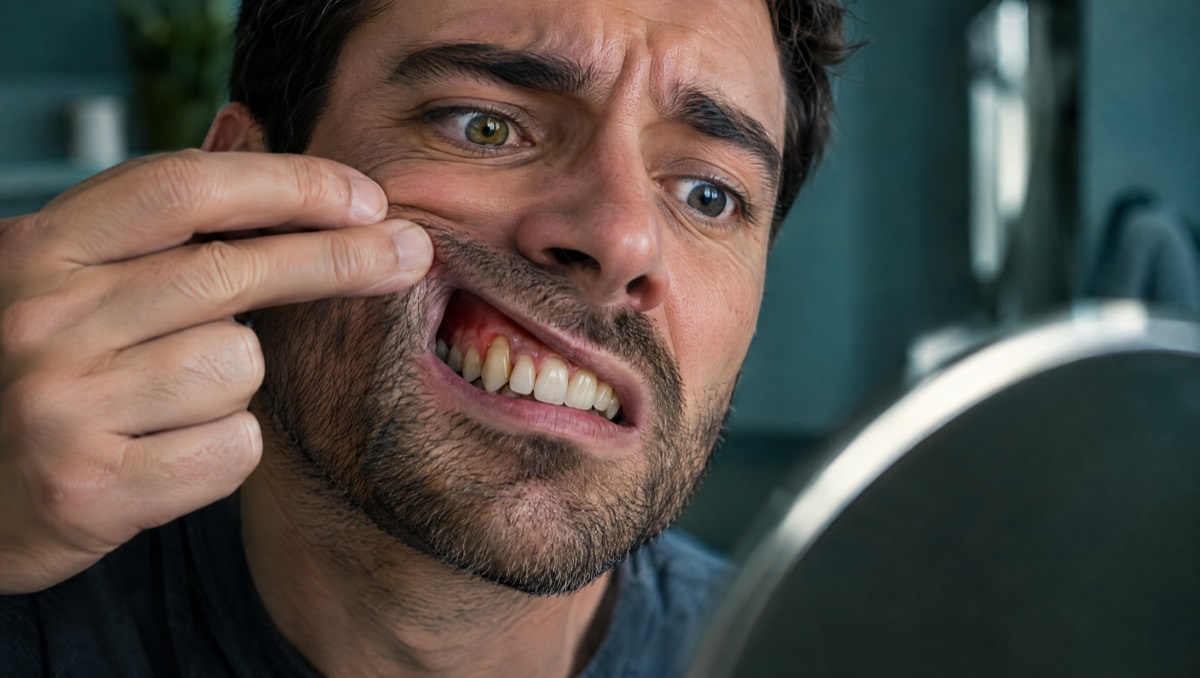
Gum recession is the gum margin moving away from the crown of the tooth, exposing root surface that was previously covered. It makes teeth look longer, creates sensitivity, and leaves the root, which has no enamel, vulnerable to decay. Receded gum tissue does not grow back on its own. It can be surgically replaced with a graft, and the recession can almost always be stopped. The two dominant causes are brushing too hard and periodontal disease, and they call for opposite responses, which is why getting the diagnosis right matters before you change anything.
Why gums recede
Aggressive brushing. Hard bristles, heavy pressure, and a horizontal scrubbing motion physically abrade the thin gum at the margin and wear a notch into the tooth beneath it. Classically affects the canines and premolars, often worse on the left in right-handed people, and the gum looks healthy and pink rather than inflamed.
Periodontal disease. Inflammation destroys the supporting bone, and the gum follows it down. Here the gum is usually red, swollen, and bleeds. The recession is a symptom of ongoing disease that needs treating in its own right; see our guide to gum disease.
Thin gum biotype. Some people are simply born with thin, delicate gum tissue and little bone covering the root. It recedes easily with minimal provocation and runs in families.
Tooth position. A tooth sitting outside the arch has little bone in front of it, so the gum has nothing to sit on. This is why recession sometimes appears or worsens during orthodontic treatment that moves teeth outward.
Grinding and clenching. Heavy occlusal forces flex the tooth at the gum line, contributing to both notching and recession. See teeth grinding.
Oral piercings. A lip or tongue stud rubbing against the gum causes localised, often severe recession.
Smoking and vaping. Reduce blood flow and worsen periodontal disease.
Age. Recession accumulates over decades, hence “long in the tooth.” It is not inevitable, though: it reflects accumulated causes rather than ageing itself.
Why it matters beyond appearance
Sensitivity. Exposed root dentin conducts cold, sweet, and touch straight to the nerve. Our guide to tooth sensitivity covers relief.
Root decay. Root surface is cementum and dentin, not enamel. It softens at a higher pH than enamel, meaning it starts dissolving with far less acid, and root cavities are harder to restore and more likely to need a crown or extraction.
Progression. Recession that is not addressed usually continues, and the further it goes the harder it is to graft successfully.
Aesthetics. Long teeth, visible root surface with a yellower colour, and black triangles between teeth where the gum used to fill the space.
Can gums grow back?
No. There is no treatment, product, or home remedy that regenerates gum tissue that has receded. Claims for oil pulling, aloe, coconut oil, special toothpastes, or “gum regrowth” supplements are not supported by evidence. What can happen is that inflamed, swollen gum shrinks back to its true position when the inflammation resolves, which sometimes makes recession look worse after a deep cleaning, and conversely, treating inflammation can make gums look slightly better. Neither is regeneration.
What is genuinely possible is surgical coverage: taking tissue from elsewhere and placing it over the exposed root.
Treatment options
Do nothing but stop the cause. For mild recession that is not sensitive, not progressing, and not bothering you aesthetically, this is a legitimate choice. Change the brushing technique, treat the gum disease, wear a night guard, remove the piercing, then monitor with photographs and measurements at each check-up.
Desensitising treatment. Sensitivity toothpaste, fluoride varnish, or a bonded resin over the exposed area. Treats the symptom, not the recession. Inexpensive.
Composite bonding. Filling the notch at the gum line with tooth-coloured resin to reduce sensitivity and improve appearance. $150 to $400 per tooth. Does not restore gum.
Connective tissue graft. The standard surgical treatment. A thin layer of connective tissue is taken from under the palate and tucked under the gum at the recession site, then the gum is advanced over it. High success rate for root coverage. $600 to $1,200 per tooth; often more for multiple teeth in one session.
Free gingival graft. Tissue taken from the palate surface and placed directly. Used to thicken tissue and stop progression rather than to cover the root fully. Colour match is less good.
Donor tissue (allograft) or growth-factor materials. Avoids a second surgical site in your palate; slightly lower predictability, similar cost, more comfortable recovery.
Pinhole surgical technique. A small hole is made and the existing gum is loosened and slid down over the roots, held with collagen strips, no cutting or sutures. Less post-operative discomfort and can treat several teeth at once. $400 to $1,200 per tooth. Evidence is reasonable for suitable cases, though long-term data is less extensive than for connective tissue grafts.
Dental insurance often covers grafting partially when it is done for function rather than purely cosmetically; expect a pre-authorisation requirement.
How to stop it getting worse
This is the part that matters most, and it is free.
- Soft brush, light pressure, correct angle. Small strokes with the bristles angled into the gum line, never horizontal scrubbing. An electric brush with a pressure sensor is genuinely useful; see our electric toothbrush guide and the technique in our brushing guide.
- Treat gum disease properly, including maintenance cleanings every three to four months if you have had periodontitis.
- Wear a night guard if you grind.
- Remove lip and tongue piercings.
- Stop smoking.
- Use a high-fluoride toothpaste if roots are exposed, to protect against root decay.
- Have recession measured and recorded at check-ups so progression is detected rather than guessed at.
When to see a dentist
See a dentist if you can see root surface, if teeth look longer than they used to, if there is a notch you can feel at the gum line, or if a specific tooth has become sensitive to cold. Go promptly if gums also bleed, are swollen or tender, or there is pus, since that indicates active gum disease driving the recession. Also book if recession is visibly progressing between check-ups, if a tooth has become loose, or if you have a lip or tongue piercing sitting against the gum. Ask for your recession to be measured in millimetres and recorded, which is the only reliable way to know whether it is advancing.
Frequently asked questions
Can receding gums grow back?
No. Gum tissue does not regenerate once lost. Recession can be stopped, and a periodontist can surgically cover exposed roots with a graft, but no toothpaste, rinse, or home remedy regrows gum.
How do I stop my gums receding further?
Identify the cause and remove it: switch to a soft brush with light pressure and the correct angle, treat gum disease, wear a night guard if you grind, remove oral piercings, and stop smoking. Then have it measured at each check-up to confirm it has stabilised.
Is a gum graft painful?
There is discomfort for several days, usually more from the palate donor site than the grafted area. Most people manage with over-the-counter pain relief and a soft diet for a week. Using donor tissue instead of your own palate reduces this considerably.
How much does a gum graft cost?
Roughly $600 to $1,200 per tooth in the US, with reductions when several teeth are treated together. Insurance often contributes when the graft is needed for sensitivity or to stop progression rather than for appearance alone.
Does receding gums mean I have gum disease?
Not necessarily. Recession from aggressive brushing occurs in healthy, non-inflamed gums. If your gums also bleed, are red or swollen, or you have been told you have deep pockets, then gum disease is the likely driver and needs treating first.