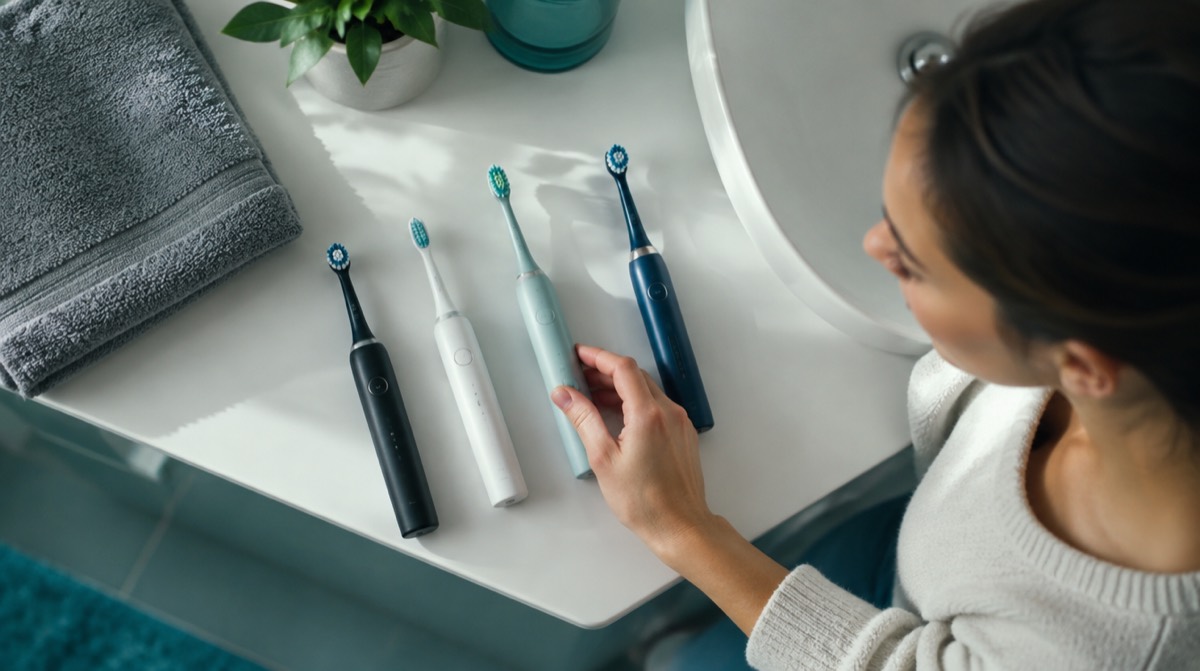
The best electric toothbrush for most people is a mid-range oscillating-rotating or sonic model with a two-minute timer and a pressure sensor, which costs $25 to $60 in the US. Clinical reviews find that electric brushes remove modestly more plaque and reduce gum inflammation slightly better than manual brushes over time, and that the benefit comes from the brush doing the motion and the timer keeping you brushing long enough, not from the app, the number of modes, or the price. Premium models at $150 and up are not measurably better at cleaning teeth.
Why electric, and what the evidence says
A Cochrane review pooling more than 50 trials found that powered toothbrushes reduced plaque by about 11 percent and gingivitis by about 6 percent more than manual brushing at one to three months, with the gap widening slightly at three months and beyond. The effect was clearest for oscillating-rotating brushes. That is a real, consistent benefit, but a modest one: a person who brushes well with a manual brush is not at a disadvantage.
The practical case for electric is behavioural. Most people brush for well under two minutes and press too hard. A timer that buzzes every 30 seconds and a sensor that lights up when you scrub too hard fix both problems automatically. If you already brush for two minutes gently, an electric brush adds a little. If you do not, it adds a lot.
Oscillating-rotating vs sonic
Oscillating-rotating (Oral-B and similar): a small round head that spins back and forth, some models with added pulsation. You place it on each tooth for a second or two rather than scrubbing. Slightly stronger evidence for plaque removal. The small head reaches back molars easily. Louder and more of a “buzzing” sensation. Oral-B’s premium iO line adds a quieter magnetic drive and a smarter pressure sensor; our Oral-B iO review covers whether it is worth the extra cost.
Sonic (Philips Sonicare and similar; see Oral-B vs Sonicare): an oval head, similar in shape to a manual brush, vibrating at 30,000 or more strokes a minute. Used with a gentle sweeping motion. Quieter, gentler feel, and the familiar shape suits people switching from manual. Evidence is good, marginally behind oscillating-rotating in head-to-head trials.
Either type cleans well. Choose by feel: try both if you can, and pick the one you will use every day.
Features worth paying for
- Two-minute timer with 30-second pacer. Non-negotiable. Almost every model from $25 up has it.
- Pressure sensor. A light or a change in vibration when you press too hard. The single best protection for your gums. Standard from about $40; check the box.
- Rechargeable battery with at least a week of charge. Anything less becomes an annoyance and ends up in a drawer.
- Replacement heads that are widely available and reasonably priced. Check the price and availability of heads before buying the handle. A cheap handle with $12 heads costs more over two years than a pricier handle with $5 heads.
- Soft bristles. Standard on the basic head; avoid “whitening” or “deep clean” heads if you have sensitive gums.
Features you can skip
- Multiple cleaning modes. “Daily clean” is the only one that matters. “Whitening,” “gum care,” and “sensitive” modes change speed slightly. Nobody uses them after week one.
- Bluetooth and an app. Brushing maps and coaching are clever for a few days. The evidence that they change long-term behaviour is thin, and they add $50 to $150.
- AI recognition and position tracking. Same category.
- Travel case, charging glass, UV sanitiser. Convenience, not cleaning.
- Very high vibration counts. Beyond a threshold, more strokes per minute do not translate to cleaner teeth.
Picks by budget
We do not rank specific models by name because the line-ups change every year and prices swing constantly. What holds is the tier:
| Budget | What you get | Who it suits |
|---|---|---|
| $25 – $40 | Timer, pacer, one mode, rechargeable, sometimes a basic pressure sensor | Most people; the best value in the category |
| $40 – $80 | Timer, pressure sensor, better battery, travel case, one or two extra modes | Anyone who wants the pressure sensor guaranteed |
| $80 – $150 | Smarter pressure feedback, app connectivity, multiple modes, premium build | People who like data and gadgets |
| $150 – $300 | Screens, colour displays, AI tracking, magnetic charging | No cleaning advantage; buy for the experience, not the results |
| Battery-powered (AA), $8 – $15 | A vibrating manual brush, usually no timer | Travel, or a child’s first electric brush |
Both major brands sell excellent brushes in the $25 to $60 tier. If you are choosing between a $40 brush and a $200 brush from the same brand, the $40 one cleans your teeth just as well.
Brush heads: the real cost
Handles last years; heads last three months. A single-user brush needs four heads a year, at $4 to $12 each depending on brand and whether you buy genuine or third-party. Third-party heads for the major brands are widely available and generally fine, though bristle quality varies; look for soft, rounded bristles. Replace sooner if bristles splay or after illness.
Using it properly
An electric brush does not need scrubbing. Hold it lightly at a 45-degree angle to the gum line, rest it on each tooth for one to two seconds, and move slowly along the arch, following the pacer through all four quadrants. Cover the outside, inside, and chewing surfaces. Spit, don’t rinse. Our brushing guide covers the technique in detail. Flossing or a water flosser is still needed for between the teeth.
When to see a dentist
An electric brush will not fix gums that bleed persistently, sensitivity that is getting worse, or receding gums; those need a check-up. See a dentist if bleeding continues after two weeks of gentle, proper brushing, if you notice notches or wear at the gum line (a sign of brushing too hard, electric or not), or if you have not had a professional cleaning in the past year. Ask your dentist or hygienist to watch you brush; it is the fastest way to find out what you are missing.
Frequently asked questions
Are electric toothbrushes really better than manual?
Slightly. Pooled clinical trials show about 11 percent less plaque and 6 percent less gingivitis than manual brushing over one to three months. The larger benefit is that the timer and pressure sensor correct the two most common brushing mistakes.
Is Oral-B or Sonicare better?
Both clean well. Trials give oscillating-rotating (Oral-B style) a small edge for plaque and gum health; sonic brushes are gentler and quieter. Choose the one that feels right and whose heads you can buy cheaply.
Is an expensive electric toothbrush worth it?
For cleaning, no. Models from $25 to $60 with a timer and pressure sensor clean as well as $200 models. The premium buys an app, a screen, and a case.
How often should I replace the brush head?
Every three months, or sooner if the bristles splay or you have been ill. Many heads have colour-fading indicator bristles.
Can kids use an electric toothbrush?
Yes, from about age 3 with a child-sized head and adult supervision. Many children brush longer with an electric brush because of the timer and novelty.