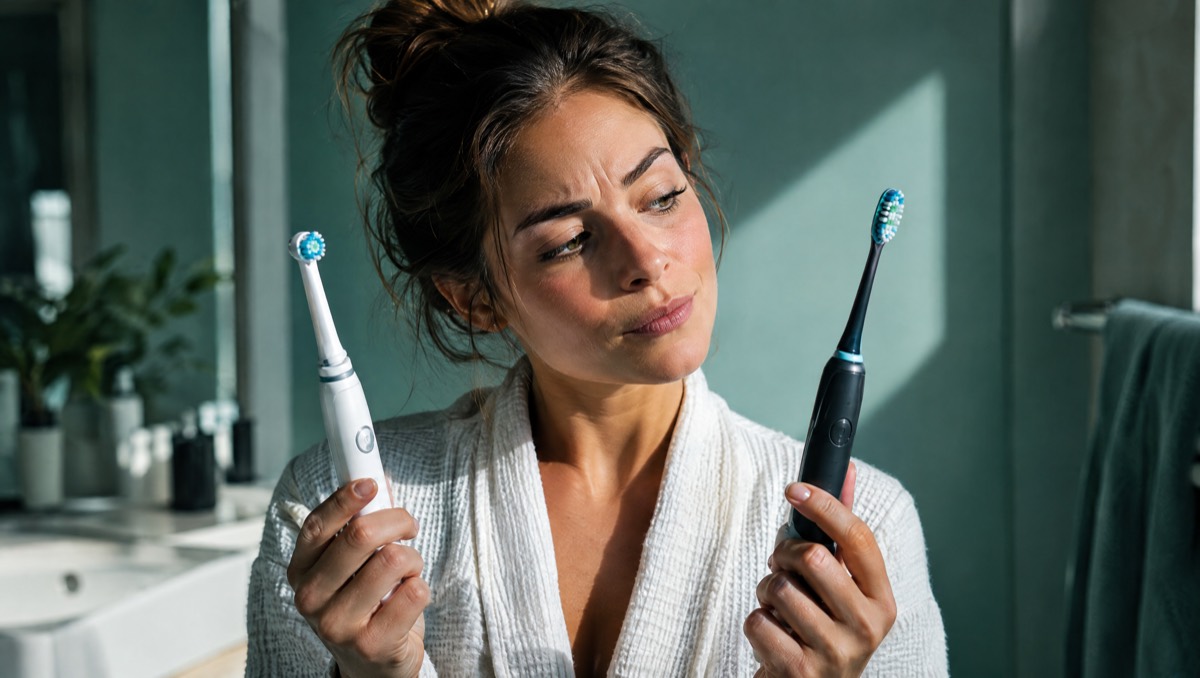
Oral-B and Philips Sonicare are the two brands that dominate electric toothbrushes in the US, and both clean far better than most people manage with a manual brush. The difference is how they move. Oral-B uses a small round head that rotates back and forth (oscillating-rotating), while Sonicare vibrates a larger, conventionally shaped head side to side at high speed (sonic). Oscillating-rotating brushes have the most clinical research behind them and a small edge in head-to-head studies, but most of that research is funded by Oral-B’s parent company. In practice, the better brush is the one whose feel you like enough to use for two full minutes, twice a day.
Quick verdict
- Choose Oral-B if you like a small head that cleans one tooth at a time, want the cheapest replacement heads, or want the option of the premium iO line.
- Choose Sonicare if you find spinning brushes loud or ticklish, prefer a larger head that feels closer to a manual brush, or have sensitive gums and want a gentler sensation.
- On a budget: an Oral-B Pro 1000 or a Sonicare 4100 (both roughly $40 to $60) does everything that affects cleaning. Premium models add comfort and apps, not cleaner teeth.
- The catch: both companies lock you into their own brush heads, so check head prices before you buy the handle.
How each brush cleans
Oral-B (oscillating-rotating). The round head is about the size of a single molar. It rotates back and forth rapidly, and most models add a pulsing movement. You guide it slowly from tooth to tooth, holding it on each surface for a second or two, rather than scrubbing. The small head reaches back molars and the inside of front teeth easily. The trade-off is noise and a distinct buzzing feel, which the newer iO models reduce with a quieter magnetic motor.
Sonicare (sonic). The head is a familiar oval shape and vibrates side to side very fast. The motion sweeps across several teeth at once and moves fluid between teeth and along the gum line. Many people find it quieter and gentler, though the high-frequency vibration tickles some users at first. You glide it along the teeth at a slight angle to the gum line.
Neither motion is dangerous to enamel or gums when used with light pressure. Pressing hard is the main way people damage gums with any brush, which is why a pressure warning is worth having.
What the research says
A Cochrane review of 56 trials found that powered toothbrushes reduce plaque by about 21% and gingivitis (gum inflammation) by about 11% more than manual brushes after three months of use. Oscillating-rotating brushes made up the largest group of trials and showed significant benefits at every time point measured.
Head-to-head comparisons between the two technologies favour oscillating-rotating brushes, but the gap is modest. A 2023 meta-analysis in the International Dental Journal found oscillating-rotating brushes reduced bleeding sites by about 29% more and plaque by about 5% more than sonic brushes. Every trial in that analysis came from Procter & Gamble’s clinical archive, the company that makes Oral-B, which is a real conflict of interest. An independent network meta-analysis of single-brushing studies also found both technologies beat manual brushes for plaque removal.
The fair reading: Oral-B’s technology has more evidence and a small measured edge; Sonicare is also clearly effective; and your technique and consistency matter more than the brand.
Side-by-side comparison
| Oral-B | Philips Sonicare | |
|---|---|---|
| Brush motion | Oscillating-rotating, small round head | Sonic side-to-side vibration, oval head |
| Feel | Firm, buzzing; quieter on iO models | Smoother, quieter, can tickle at first |
| Evidence base | Largest; small edge in head-to-head trials | Strong vs manual; fewer head-to-head wins |
| Entry model | Pro 1000, about $40 to $50 | ProtectiveClean 4100, about $40 to $60 |
| Premium model | iO series, about $80 to $350 | DiamondClean series, about $180 to $230 |
| Pressure warning | Yes on most models; three-colour ring on iO | Yes on most models from the 4100 up |
| Genuine head cost | About $4 to $8 (iO heads $8 to $12) | About $6 to $10 |
| ADA Seal of Acceptance | Check the specific model in the ADA’s product search | Check the specific model in the ADA’s product search |
Prices are typical US retail ranges and change often, especially around sales.
Cost of ownership
The handle is a one-off purchase that should last several years. Heads are replaced every three months, or sooner if the bristles splay, so you buy four a year for each person using the brush.
- Oral-B standard heads: roughly $16 to $32 a year
- Oral-B iO heads: roughly $32 to $48 a year
- Sonicare heads: roughly $24 to $40 a year
Over three years, the head bill can exceed the price of an entry-level handle. Multipacks and subscription discounts narrow the gap; compatible third-party heads are cheaper but vary in quality.
Which is better for your situation?
Sensitive teeth or receding gums. Both work if you use light pressure and a soft head. Many people with sensitive gums prefer Sonicare’s gentler sensation, and both brands make sensitive-mode settings and extra-soft heads. A pressure warning matters more than the brand here. See our guide to tooth sensitivity.
Braces. Both can clean around brackets. Oral-B’s small head is easy to angle around each bracket; Sonicare’s sweeping motion covers more surface per pass. Pair either with a water flosser or floss threaders. Our guide to cleaning teeth with braces covers the full routine.
Tight budget. Buy the entry model of whichever brand has cheaper heads where you shop. A $40 to $50 brush with a timer and pressure sensor, used properly, cleans as well as a $250 model.
You want the premium experience. The Oral-B iO and Sonicare DiamondClean both add quieter motors, more modes, travel cases and app tracking. Our Oral-B iO review covers whether those extras are worth paying for.
You share a bathroom. Sticking to one brand lets everyone use the same charger and buy heads in bulk.
Features worth paying for (and ones that aren’t)
Worth it: a two-minute timer with a 30-second pacer, a pressure warning, and a battery that lasts at least a week between charges.
Nice but optional: multiple modes (Daily Clean is the one that matters), travel case, charge indicator.
Rarely used: app connectivity and position tracking. Many people stop using the app after the first few weeks. For more on choosing features, see our best electric toothbrushes guide and our overview of how electric toothbrushes work.
Getting the most from either brush
Whichever you choose, technique decides the result. Let the brush do the work, use light pressure, angle the bristles toward the gum line, spend 30 seconds on each quarter of the mouth, and clean between your teeth once a day. Our step-by-step guide to how to brush your teeth covers the details.
When to see a dentist
No toothbrush fixes an existing problem. See a dentist if your gums bleed after two weeks of gentle, consistent brushing, if your gums are receding or you notice notches at the gum line, if a tooth is sensitive to hot, cold or sweet for more than a few days, or if it has been more than a year since your last check-up and cleaning. Ask your hygienist to watch you brush; they can correct technique in a minute.
Frequently asked questions
Is Oral-B or Sonicare better for plaque removal?
Studies comparing the two favour Oral-B’s oscillating-rotating technology by a modest margin, but most of those trials were funded by Oral-B’s parent company. Both remove substantially more plaque than a manual brush. Using either one properly for two minutes twice a day matters more than the brand.
Do dentists recommend Oral-B or Sonicare?
Dentists recommend both, and both brands sell products that carry the ADA Seal of Acceptance; the ADA’s online product search shows which specific models are accepted. Many hygienists like Oral-B’s small round head for reaching individual teeth, while others suggest Sonicare for patients with sensitive gums. The best choice is the one you will use consistently.
Which is gentler on gums, Oral-B or Sonicare?
Many people find Sonicare’s sonic vibration gentler and quieter. However, both are safe for gums when used with light pressure and a soft head. The biggest risk to gums is pressing too hard, so choose a model with a pressure warning whichever brand you buy.
Are Sonicare brush heads more expensive than Oral-B?
Usually, yes. Genuine Sonicare heads typically cost about $6 to $10 each, while standard Oral-B heads cost about $4 to $8. Oral-B’s iO heads are the exception at roughly $8 to $12. Since you replace heads every three months, this difference adds up over the life of the brush.
Can I use Sonicare heads on an Oral-B handle?
No. Each brand uses its own connection, so heads are not interchangeable. Even within Oral-B, iO heads only fit iO handles. Check head compatibility and price before buying a handle.