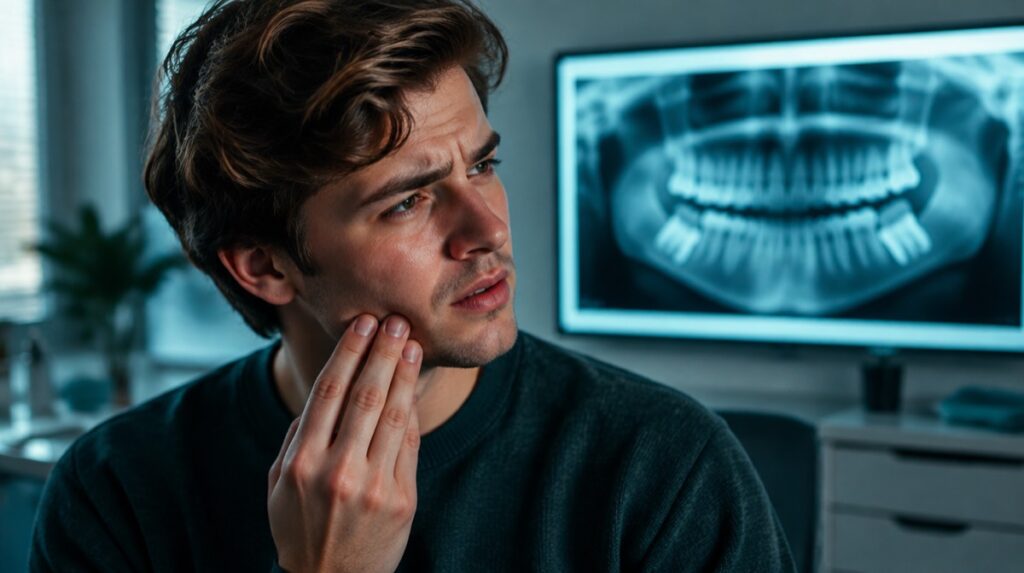

Some tooth pain after a root canal is normal. Most people feel soreness or tenderness when biting for a few days while the tissues around the root settle. A large review found pain was common the day after treatment but uncommon by one week. Severe pain, swelling, or pain lasting more than a few days is a reason to call your dentist.
Why does a tooth hurt after a root canal?
A root canal removes the inflamed or infected pulp (the soft tissue inside the tooth) and seals the canals. The nerve inside the tooth is gone afterward, but the tooth still sits in a ligament and bone that have nerves of their own. Those tissues can be irritated by the original infection and by the cleaning and shaping of the canals. That is why the tooth often feels tender when you bite or tap on it, rather than sensitive to cold.
Other common, short-lived causes of soreness:
- The injection site and jaw. Holding your mouth open for a long appointment can leave the jaw and the injection spot achy for a day or two.
- A temporary filling that sits a little high. If the tooth hits first when you close, every bite presses on a sore ligament. A dentist can adjust this quickly.
- Pain before treatment. People who had a lot of pain or an infection before the root canal are more likely to have soreness afterward.
Our root canal guide explains what the treatment involves and why it’s done.
Root canal recovery timeline
Every tooth and person is different, but this is the pattern most patients describe and most studies show.
| Time after treatment | What’s typical | What’s not typical |
|---|---|---|
| First few hours | Numb lip, cheek and tongue while the anesthetic wears off | Bleeding that won’t stop |
| Day 1 | Soreness or tenderness when biting; peak for many people. About 40% report some pain at 24 hours | Severe, throbbing pain that pain relievers don’t touch |
| Days 2 to 4 | Soreness easing day by day | Pain getting worse, new swelling, fever |
| About 1 week | Most people have little or no pain. About 11% report some pain at one week, usually mild | Pain that’s still strong or keeps you up at night |
| Weeks until the crown | Tooth feels mostly normal but is fragile under a temporary filling | Temporary filling falling out or cracking |
| Long term | Tooth feels and works like a normal tooth after its final restoration | New pain, swelling or a gum bump months or years later |
The 24-hour and one-week figures come from a 2011 systematic review in the Journal of Endodontics that pooled 72 studies. Average pain scores fell from 54 out of 100 before treatment to 24 at one day and 5 at one week. In other words, for most people a root canal relieves pain rather than causing it.
Managing pain in the first few days
The AAE notes that over-the-counter or prescription medicine can help with soreness after treatment, and that you should follow your endodontist’s instructions.
For short-term dental pain in adults and teens 12 and older, a 2024 guideline endorsed by the American Dental Association names NSAIDs (such as ibuprofen or naproxen), alone or combined with acetaminophen, as the first choice. It reserves opioids for the uncommon cases where those don’t control the pain. NSAIDs aren’t safe for everyone, including some people with stomach ulcers, kidney disease or certain heart conditions, so check with your dentist or pharmacist about what fits you.
Other things patients often find helpful:
- Avoid biting on the treated side until the tenderness settles.
- Keep foods and drinks lukewarm rather than very hot or cold.
- Rinsing gently with lukewarm salt water, which Colgate’s patient guide mentions as a simple comfort measure.
What to eat after a root canal
Colgate’s guide advises waiting to eat until the numbness has completely worn off, so you don’t bite your cheek, lip or tongue without noticing.
Good choices for the first few days: scrambled eggs, yogurt, smoothies, oatmeal, mashed potatoes, pasta, soft fish, cooked vegetables, lukewarm soup and soft bread.
Best to avoid until the final restoration is in:
- Sticky foods like caramel, taffy and gum, which can pull out a temporary filling or crown.
- Hard foods like ice, hard candy, nuts and peanut brittle, which can chip or crack the tooth.
- Very hot or very cold foods and drinks if the area is sensitive.
You can brush and floss as usual. Colgate suggests sliding floss out sideways near a temporary filling or crown instead of snapping it up, so you don’t dislodge it.
Why the crown or final filling matters
After the canals are sealed, many teeth get a temporary filling first and a permanent filling or crown at a later visit. A tooth with a temporary is more fragile and more likely to leak.
According to the AAE (as summarized by Colgate), a delay in placing the permanent restoration raises the chance the canal gets reinfected. Back teeth that do the heavy chewing are commonly crowned after a root canal. A large US study of more than 71,000 root canal-treated teeth in general dental practices found that teeth that received a crown survived years longer on average than teeth that didn’t. That study was observational, so it can’t prove the crown alone made the difference.
If you’re weighing the options for a treated tooth, see our guides to dental crowns and crown vs filling.
Why does my root canal tooth hurt months or years later?
Root canals have a high success rate. A study cited by Colgate puts overall success between 86% and 98%. But a treated tooth can still develop problems later. Pain in a root canal tooth after 2 years, 10 years or longer usually points to something new rather than a slow recovery.
Common reasons the AAE lists:
- A leaking or broken restoration. A crown or filling that cracks, loosens or breaks lets bacteria back into the canals.
- New decay on the same tooth, often at the edge of a crown.
- Missed or hard-to-reach canals. Some teeth have tiny or curved canals that can be missed during the first treatment.
- A crack in the root. A vertical root fracture can cause pain or a gum bump years later, and it often can’t be fixed.
Signs the AAE describes as worth a visit include lingering pain with hot or cold, sharp pain when biting, constant pain and pressure, gum swelling with or without a pimple-like bump, and a dull ache in the same spot.
A dentist or endodontist usually starts with an exam and X-rays, and sometimes a 3D scan. Depending on the cause, options can include a new crown, root canal retreatment, a small surgery at the root tip (apicoectomy), or removing the tooth. Our root canal vs extraction guide compares the last two.
Tooth that needs a root canal vs a tooth healing from one
People sometimes confuse the two because both can hurt.
| Tooth that may need a root canal | Tooth healing after a root canal | |
|---|---|---|
| Type of pain | Often lingering pain with hot or cold, throbbing, pain that wakes you | Tenderness or soreness when biting or tapping |
| Cold sensitivity | Common, and lasts after the cold is gone | Usually none, because the pulp has been removed |
| Direction | Often gets worse over time | Gets better day by day |
| Swelling or gum bump | Can be a sign of infection (tooth abscess) | Not expected; call your dentist |
Only an exam and X-ray can tell what’s going on with a specific tooth.
When to see a dentist
Call your dentist or endodontist if you have severe pain or pressure, pain that lasts more than a few days or gets worse instead of better, visible swelling inside or outside your mouth, a pimple-like bump on the gum, a bite that feels uneven, a temporary filling that falls out, an allergic reaction to a medicine, or a return of the symptoms you had before treatment. Get emergency care right away for facial or neck swelling that is spreading, fever with swelling, or trouble breathing or swallowing. Our emergency dentist guide explains what counts as urgent.
Frequently asked questions
How long does pain last after a root canal?
For most people, soreness lasts a few days and is mostly gone within a week. In a review of 72 studies, about 40% of patients had some pain one day after treatment and about 11% at one week, with average pain levels low by day seven. Pain that’s severe or lasts longer than a few days should be checked.
Is it normal for a root canal tooth to hurt when I bite?
Yes, for the first few days. The tissues around the root are often irritated, so pressure from chewing can feel sore even though the nerve inside the tooth is gone. If biting pain doesn’t ease, or the tooth seems to hit first when you close, a dentist may need to adjust the filling or check the tooth.
When can I eat normally after a root canal?
You can eat once the numbness wears off, starting with soft, lukewarm foods and chewing on the other side. Until the permanent filling or crown is placed, it’s wise to avoid hard and sticky foods that could crack the tooth or pull out a temporary. Once the final restoration is in, most people eat normally.
Why does my root canal tooth hurt years later?
Usually because of a new problem: a crown or filling that has leaked or broken, new decay, a canal that wasn’t fully cleaned the first time, or a crack in the root. These can let bacteria back in. Many such teeth can be retreated, but some cracked teeth need to be removed. An exam and X-rays are needed to find the cause.
Can a tooth still feel cold after a root canal?
Strong, lingering cold sensitivity isn’t expected in a fully treated tooth, because the pulp has been removed. The AAE lists lingering pain with hot or cold as a sign worth a visit. Sometimes the sensitivity is actually coming from a neighboring tooth or the gums, so an exam is the way to sort it out.