
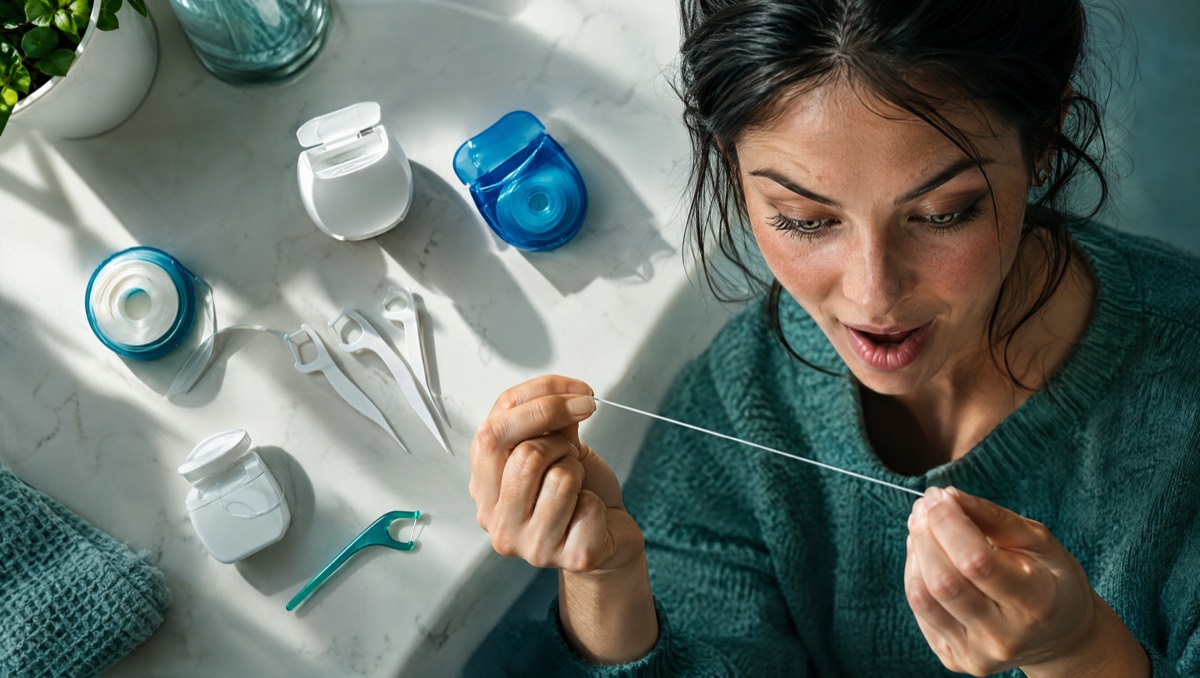
Floss picks (floss sticks) are good enough for most people. Several small clinical trials found that floss holders and pick-style flossers removed plaque and reduced gum inflammation about as well as finger flossing. String floss can wrap around each tooth more closely, but a pick you use every day beats a spool that stays in the drawer.
Quick verdict
- Choose floss picks if string floss is awkward for you, you have trouble reaching your back teeth, you have limited hand dexterity, or you are helping a child floss.
- Choose string floss if you are comfortable using it, have tight or crowded teeth, or want to wrap the floss snugly around each tooth.
- Cost: both are inexpensive. Disposable picks usually cost a little more per use than a spool of floss; a reusable floss holder with refills sits in between.
- The catch: a pick uses the same short piece of floss for your whole mouth, so rinse it as you go and use a new pick each day. If you have braces, bridges or wide gaps, a different tool may suit you better.
Floss picks vs string floss at a glance
| Floss picks (floss sticks) | Reusable floss holder | String floss | |
|---|---|---|---|
| What it is | A short strand of floss on a small plastic handle, used once | A handle you thread with fresh floss or refill heads | A length of floss wound around your fingers |
| Ease of use | Easiest, one-handed | Easy once loaded | Takes practice |
| Reaching back teeth | Good | Good | Harder for some people |
| Wrapping around the tooth | Limited, floss is held taut | Limited | Best |
| Clean floss for each gap | No, same strand throughout | Depends on design | Yes, move to a fresh section |
| Plastic waste | Most | Less | Least |
| Plaque and gingivitis in trials | Similar to string floss | Similar to string floss | The usual comparison standard |
Do floss picks work as well as string floss?
The best evidence comes from a handful of small randomized trials that compared floss holders or pick-style flossers with ordinary finger flossing:
- Spolsky 1993 (UCLA): 35 adults who did not usually floss tried a flossing aid and finger flossing for 30 days each. There was no statistically or clinically significant difference in plaque or gingivitis between the two.
- Carter-Hanson 1996: 30 non-flossing adults used a flossing device and finger flossing for 30 days each. Both improved plaque, gingivitis and bleeding, with no significant difference between them, and no gum injury with either.
- Yost 2006: 120 adults used Glide floss, disposable flossers, a soft-pick style cleaner or an interdental brush for six weeks. Flossers matched floss for plaque and gingivitis. This study was run by the maker of three of the products tested.
A lab study at Tokyo Dental College in 2020, using a jaw model with artificial plaque, found finger-wound floss removed the most plaque on premolars and molars, and holder-type floss did slightly worse in some areas. That fits the main trade-off: floss on your fingers can be angled around each tooth more easily, while a pick holds it straight.
These trials were short and fairly small, and the wider evidence for flossing itself is modest. A 2019 Cochrane review found that flossing plus brushing may reduce gingivitis compared with brushing alone, but rated the evidence low certainty. See our guide on how often you should floss for what that means in practice.
Why picks may help you floss more often
The main advantage of a floss pick is that people are more likely to use it. In an older study of people who had tried both methods, 70% preferred the floss holder at the end. Six months later, half of the former non-flossers were still flossing at least twice a week, and 85% of those were using the floss holder rather than their fingers.
A 2020 trial in 142 adults with gingivitis found that people given a floss holder reported flossing more over four months than people using finger floss. Gum bleeding improved significantly only in the group that also got text-message reminders, which is a reminder that habit matters as much as the tool.
Floss holders and long-handled flossers
A floss holder is a reusable handle that holds a strand of floss tight between two prongs. Some you thread with floss from a spool; others take snap-on refill heads. Long-handled flossers, sometimes sold as “reach” flossers, put the floss on a handle shaped like a toothbrush so you can get to the back teeth without putting your fingers in your mouth.
These can help:
- People with arthritis, hand tremors or limited grip
- People with a small mouth opening
- Parents flossing a child’s teeth
- Anyone who gags when reaching to the back with their fingers
In a 2011 trial in adults with systemic sclerosis, a condition that can narrow the mouth opening, a package of a powered toothbrush and a long-handled flosser improved gum inflammation more than a manual brush and finger floss over six months. The study tested the two devices together, so it does not show the flosser alone made the difference.
How to choose floss picks
1. Look for the ADA Seal. To earn it, a company must show that using the product with brushing cuts plaque and gingivitis more than brushing alone. In the ADA’s Seal product search, listed floss picks include DenTek Floss Picks (Triple Clean and Complete Clean versions), DenTek Kids Fun Flosser Floss Picks and up&up Floss Picks. The Seal is voluntary, so a product without it is not necessarily worse. 2. Match the floss to your teeth. If your teeth are tight or floss tends to shred, a pick with smooth, shred-resistant floss is easier. Our waxed vs unwaxed floss guide covers the floss types, including the PTFE (glide-style) floss used on some picks. 3. Check the handle. A flat toothpick end can help dislodge food, but it does not replace flossing. A longer handle helps if back teeth are hard to reach. 4. Consider a reusable holder if the plastic waste of disposable picks bothers you.
Oral-B also sells floss picks. We could not find them in the ADA’s Seal listing, so we have not included them in the list above.
Using a floss pick the right way
The ADA notes that interdental products can wear out and may put bacteria from earlier use back in your mouth, so it says to throw them away after one use. Within a single session:
- Ease the floss gently between two teeth with a back-and-forth motion. Don’t snap it down onto the gum.
- Press the floss against the side of one tooth and slide it up and down, just under the gum line, then do the same on the neighboring tooth.
- Rinse the pick under the tap between gaps, or switch to a fresh one if the floss frays.
When string floss or another tool is a better fit
- Braces, bridges or permanent retainers. A standard pick cannot get under a wire or a bridge. Floss threaders, special orthodontic flossers or a water flosser work better. See our guide on how to clean teeth with braces.
- Wider gaps between teeth. Interdental brushes clean these spaces more thoroughly than floss in many people. The 2019 Cochrane review found interdental brushes may reduce gingivitis more than floss.
- Difficulty with any manual tool. A water flosser may be easier. Our Waterpik vs floss comparison covers the evidence.
- Curious about expanding floss. Our BURST expanding floss review looks at what the brand claims and what has actually been studied.
When to see a dentist
See a dentist if your gums bleed every time you floss for more than a week or two, if floss or picks always catch or shred between the same two teeth, if food keeps packing into one spot, or if you notice swelling, pus, a bad taste or a tooth that feels loose. These can point to gum disease, a cavity or a broken filling. Our guide to bleeding gums covers the common causes.
Frequently asked questions
Are floss picks as good as regular floss?
For most people, yes. Small randomized trials found floss holders and pick-style flossers reduced plaque and gingivitis about as well as finger flossing over 30 days to six weeks. String floss can be wrapped around each tooth more closely, so it may have an edge on curved back teeth, but daily use matters more than the tool.
Are floss picks bad for your teeth?
No. Used gently, floss picks are safe for teeth and gums, and one trial found no gum injury with a flossing device. Problems come from snapping the floss down hard onto the gums, or reusing the same pick for days. The ADA says to throw interdental products away after one use.
Can you reuse floss picks?
The ADA recommends against it. Used floss can fray and lose effectiveness, and it can put bacteria from earlier use back in your mouth. Rinse the pick between gaps during one session, then throw it away. If you want less waste, a reusable floss holder with fresh floss or refill heads is an alternative.
What is the best floss holder?
The best floss holder is one you will use every day and that reaches your back teeth comfortably. Long-handled flossers help people with limited grip or a small mouth opening. Products with the ADA Seal, such as several DenTek floss picks and up&up Floss Picks, have shown they reduce plaque and gingivitis when used with brushing.
Are floss picks good for kids?
Floss picks can make flossing easier for children and for parents helping them. Some kid-sized picks, such as DenTek Kids Fun Flosser Floss Picks, are listed in the ADA’s Seal product search. A pick also makes it easier for a parent to reach a child’s back teeth when helping them floss.